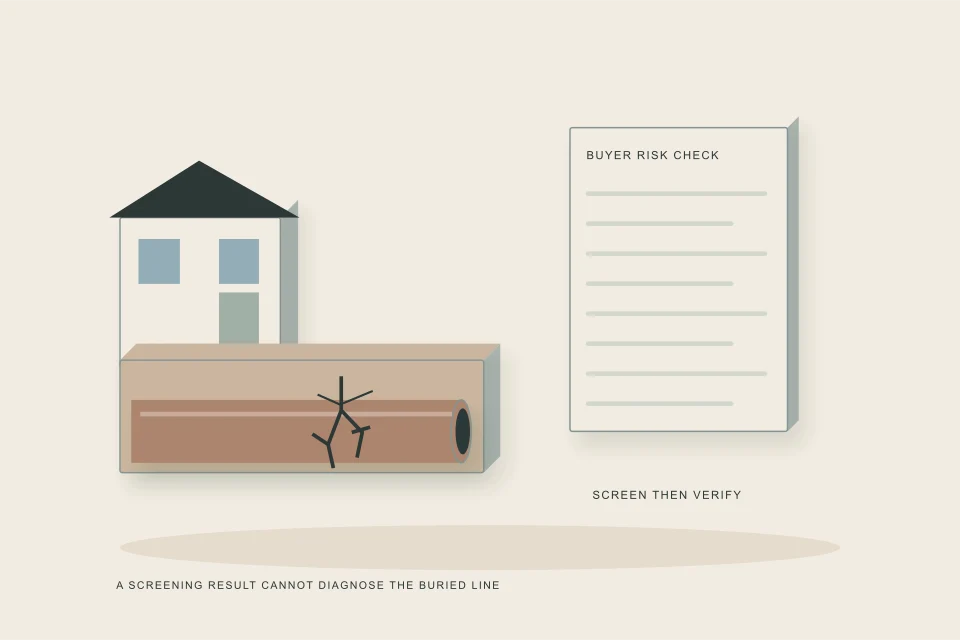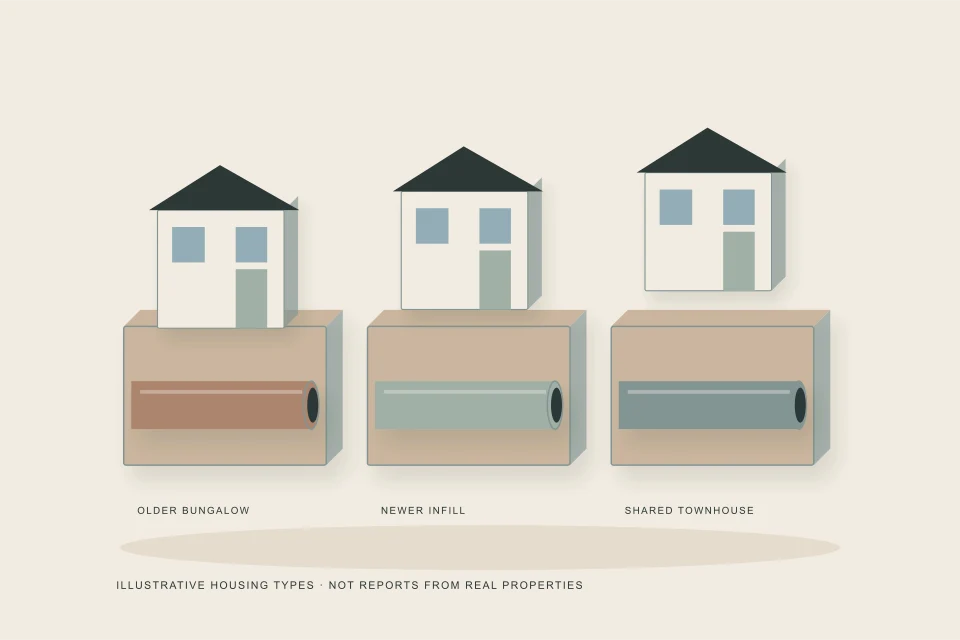
These sewer scope case studies are illustrative composites, not records of real inspections or real clients. Each describes a typical Calgary house type, what a scope commonly finds in it, what evidence the buyer should hold, and the realistic options: waive, ask for cleaning, negotiate a credit or repair, or walk away. Costs are 2026 planning ranges, not actual invoices.
- Every example on this page is illustrative: the houses, findings and outcomes are composites built to show how decisions work, not reports of real inspections.
- The same defect leads to different decisions depending on where it sits, how deep it is and how much of the line the camera could see.
- A home inspection that finds no plumbing issues says nothing about the buried lateral; each example assumes the house passed one.
- The deciding evidence in every case is the same: full video, distances, a surface locate and a written quote.
01 /Why are these examples illustrative rather than real case studies?
These examples are illustrative because SewerScope.ca is an information site, not an inspection company, and it has no inspections of its own to report. Earlier versions of this page presented named properties and exact repair invoices; those could not be verified and have been replaced. What remains is more useful: typical Calgary house types, the findings a scope commonly produces in them, and the decision a buyer faces afterward.
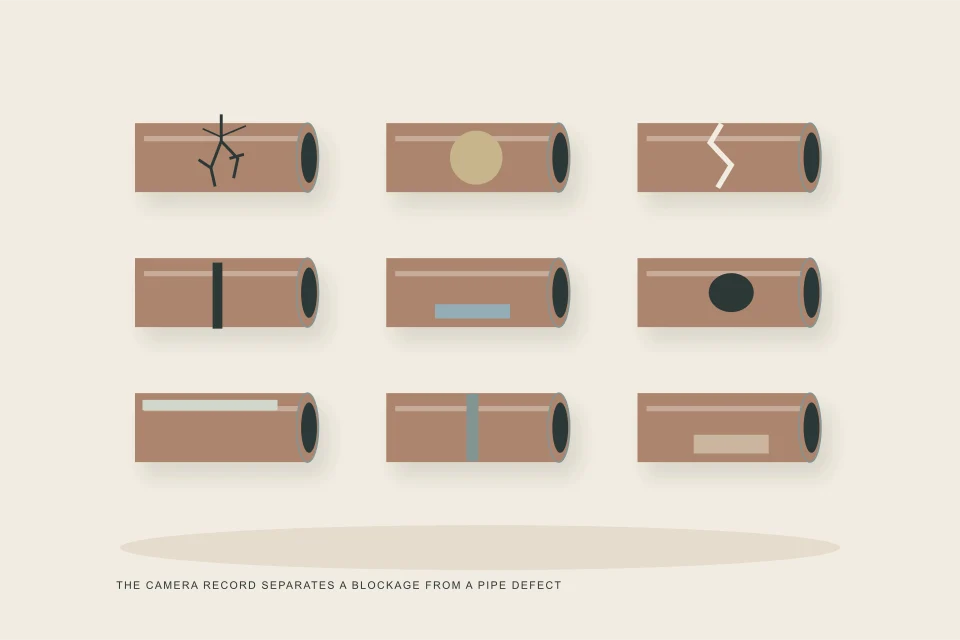
| Example | House type | Finding | Typical buyer response |
|---|---|---|---|
| 1 | Renovated 1950s bungalow, inner city | Collapsed section under the driveway | Seller repairs before closing, or large credit |
| 2 | 1960s half duplex with a boulevard tree | Dense root mass at a joint | Price adjustment; buyer plans lining |
| 3 | 1940s character bungalow | Flattened fibre pipe along most of the run | Buyer walks away |
| 4 | 1970s split level, clay tile | Sag holding water plus an offset joint | Seller-funded spot repair |
| 5 | 1960s bungalow, no cleanout | Camera stopped at a blockage part way | Condition extended for a clean and re-scope |
| 6 | 2005 two-storey, PVC | Clear line, minor debris | Buyer waives with a baseline video on file |
02 /Example 1: what happens when a scope finds a collapse under a driveway?
A collapse under a driveway usually becomes the biggest item in the negotiation. Picture a 1950s bungalow in an older inner-city community such as Inglewood, where the City's records put the median public-side install year at 1954. The kitchen and bathrooms are new and the home inspection flagged nothing in the plumbing. The camera travels about 5 metres, meets a section where the pipe crown has dropped into the bore, and cannot continue.
The locate places the collapse under the concrete driveway, roughly 2 metres down and well inside the property line. That makes it the owner's pipe and an excavated repair through concrete. Calgary open-cut work typically plans at $14,000 to $40,000 for a full replacement, and a spot repair at $4,500 to $12,000 before surface restoration. In this example the buyer's Realtor presents the video and a written quote, and the seller chooses to complete the repair before closing, with the buyer's lawyer handling proof of completion.
03 /Example 2: how does a root mass in a duplex line change the price?
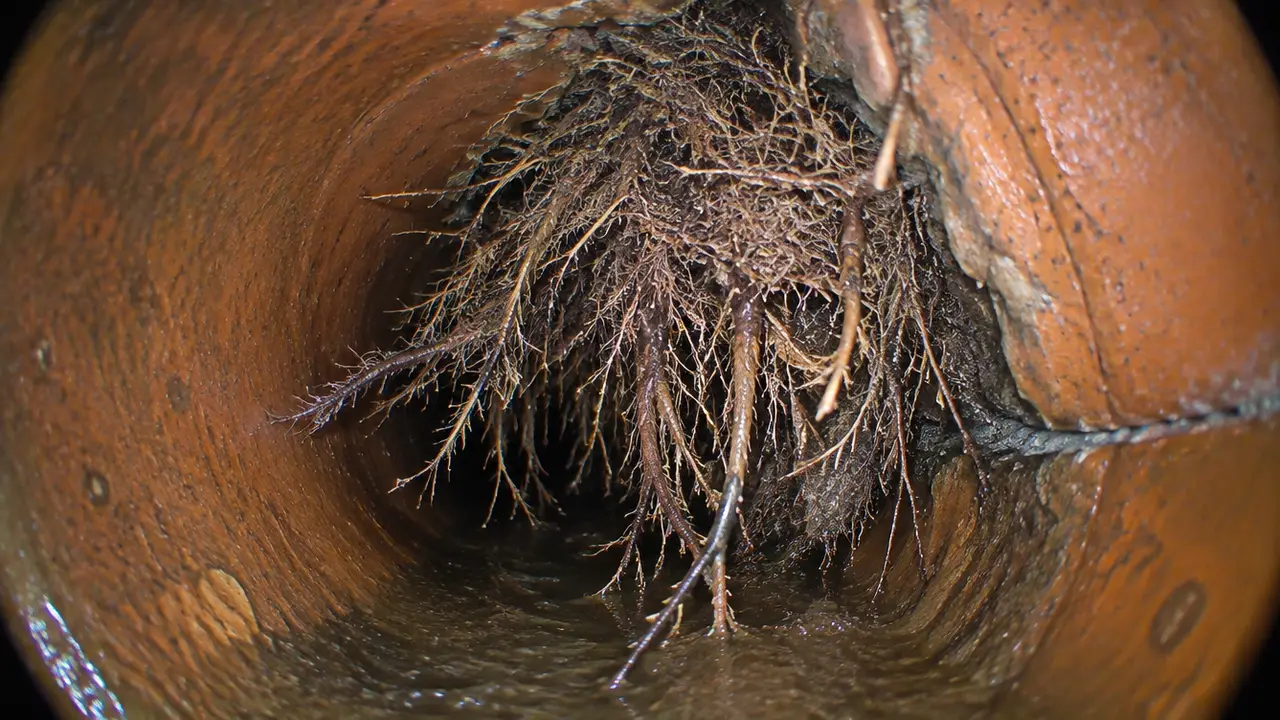
A root mass usually changes the price rather than the purchase. Imagine a 1960s half duplex bought as a rental, with a large tree on the City boulevard near the front property line. The scope shows fine roots at several joints and a dense mass blocking much of the pipe near 16 metres. The tenant has reported slow drains.
Roots can be cut and flushed, but in jointed clay they tend to return, so the buyer asks a contractor about cleaning now and lining later. The locate puts the mass just inside the property line, so it is on the private side even though the tree is the City's. The buyer negotiates a price adjustment close to a trenchless lining quote, which in Calgary typically plans at $10,000 to $30,000 for a full lateral, and schedules cleaning for the week after possession.
04 /Example 3: when does a buyer walk away?
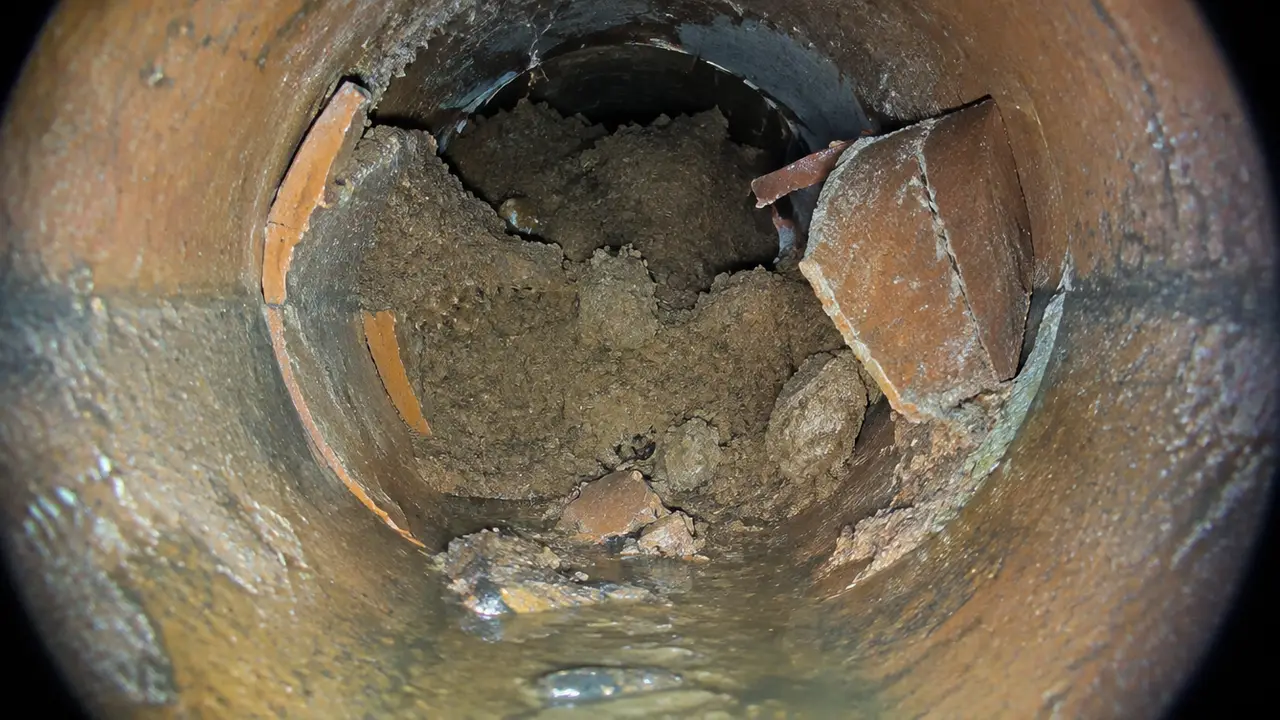
A buyer usually walks away when the whole line needs replacing, the depth makes it expensive, and the seller will not move. Consider a 1940s character bungalow with original woodwork. The camera shows a fibre-based pipe, often called tar paper pipe, that has deformed from round to oval and flattened in several places; the head barely passes. Most of the 12-metre private run looks the same.
Fibre pipe that has deformed like this cannot be spot-repaired in any meaningful way. The contractor's estimate is a full replacement at a deep bury, with trees and a front walk in the way. The seller declines a credit, and the buyer lets the condition lapse, which under Alberta practice means the offer becomes void if the condition is not waived by the deadline. The scope fee bought a clean exit.
05 /Example 4: what does a sag with an offset joint usually lead to?
A sag with an offset joint usually leads to a spot repair if both sit together in one short stretch. Picture a 1970s split level in a clay tile community such as Brentwood, where 92.5 percent of public-side lines are coded TIL, generally read as clay tile. The scope shows standing water across about 3 metres mid-run, grease and debris collecting in it, and an offset joint just downstream letting soil in.
Because both defects fall in one short section on the private side, a contractor quotes a single excavated spot repair. The estate selling the house agrees to pay for it before possession, and the buyer asks for a post-repair camera run to confirm the new section sits on grade.
06 /Example 5: what if the camera cannot finish the run?
If the camera cannot finish the run, the report is incomplete and the buyer should treat it that way. Imagine a 1960s bungalow with no cleanout. The toilet is pulled, the camera goes in, and it stops at 11 metres against a blockage. Nothing beyond that point is known.
The buyer's Realtor asks for a short extension in writing so the line can be cleared and re-scoped. An extension like this is normally agreed in writing by both sides before the original deadline passes, using the brokerage's forms; here the seller agrees to three days. The second pass shows roots at two joints but no structural failure, and the buyer waives with a cleaning schedule in mind. The deadline planner flags no-cleanout houses for exactly this reason.
07 /Example 6: is a clean scope on a newer house a wasted fee?
A clean scope on a newer house is rarely wasted, because it becomes a baseline. Picture a 2005 two-storey in a suburban community where the City's records show PVC throughout. The scope shows a clear PVC line with a little construction debris near the main. The buyer waives the condition and keeps the video; if a backup ever happens, they can compare footage and show what changed.
Newer houses can still hide sags from poor bedding and debris left from construction, which is why the home buyer guide suggests offering the scope on any resale home.
08 /What do all six examples have in common?
- The home inspection could not see the buried line in any of them.
- The decision turned on location and depth, not just the defect's name.
- A written quote, not a guess, set the size of every ask.
- Time mattered: the scope was booked early enough to leave room for a quote.
Common sewer line problems in Calgary explains each defect in more depth, and after a bad sewer scope sets out the decision path. To book a scope, send a request.
FAQQuestions people ask
Are the SewerScope.ca case studies real inspections?
No. They are illustrative composites built from typical Calgary house types and common scope findings. They do not describe real addresses, clients or invoices.
Why were the original named case studies removed?
Named properties and exact repair costs could not be verified, so they were replaced with clearly labelled examples that teach the same decisions without presenting unverified claims.
Can a seller be required to fix a sewer defect before closing?
Only by agreement. A scope result gives the buyer grounds to ask for a repair, credit or price change, but the seller can refuse, and the buyer then decides whether to waive or walk.
What if the camera stops halfway through the line?
The report should say where and why it stopped. Ask whether cleaning or another access point can finish the run, and consider asking for a written extension if the deadline is close.
NETWORKGo deeper across the HAUSE Sewer network
Should you scope the sewer before buying a house?
When a sewer scope before buying a house is worth it, which homes need one most, how to fit it inside a condition period, and what to do with the result.
SewerQuotes.comSewer camera inspection cost, and what the fee should include
Sewer camera inspection cost in Canada for 2026: standalone, pre-purchase and add-on scope prices in CAD, what a proper report includes and when the fee is wasted.
SewerRoots.caRoots found in the sewer line during a home inspection: what to do next
Roots found in the sewer line at a home inspection or sewer scope? How to read the finding, get repair quotes before conditions expire, and negotiate.