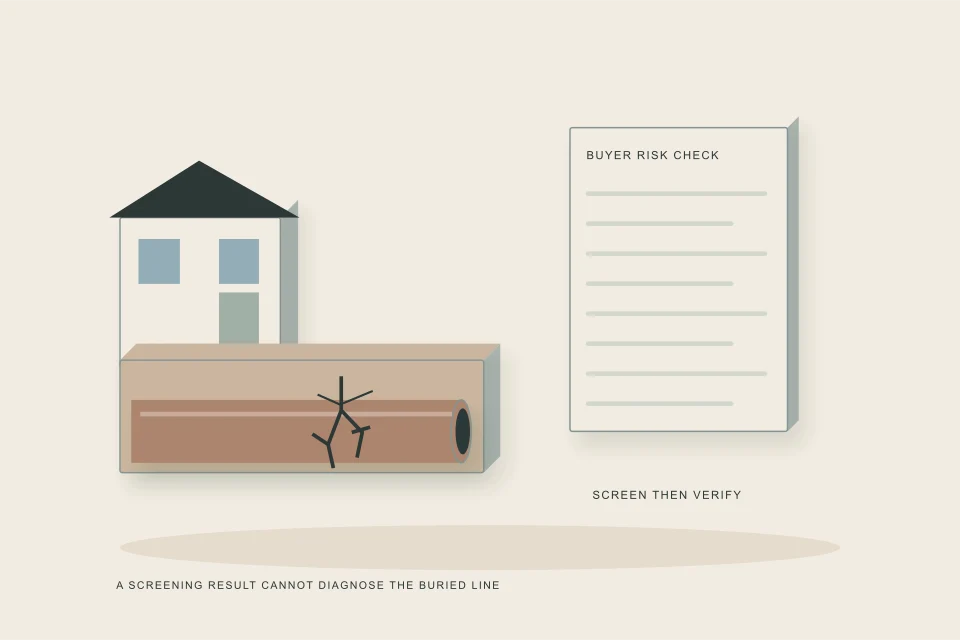
The Buyer Sewer Risk Check adds points for six facts about a Calgary house: pipe material, year built or installed, large trees near the line, a finished basement, the seller's disclosure and any scope result. The total falls into Low, Moderate, High or Very high, with the reasons listed and a checklist that always starts with getting a sewer scope before your conditions are firm.
- It is a transparent points total: every reason that added or removed points is shown under the band.
- Old or unknown material adds 3, a pre-1980 year adds 2, and a scope with defects adds 3; a clean scope removes 2.
- A score of 6 or more adds two checklist items: a written repair or replacement quote, and a talk with your REALTOR® and lawyer about the options.
- The optional address lookup reads the City's record for its own section of the line only; the private section may be different.
Buyer Sewer Risk Check
01 /What is the Buyer Sewer Risk Check for?
The Buyer Sewer Risk Check is for the first hour after you decide a house is worth an offer, or the first hour after an offer is accepted. It asks what you can learn quickly, from the listing, a walk around the lot and a question to the seller's side, and converts those answers into a band that tells you how much weight the sewer line deserves in your due diligence.
It is not an inspection and does not pretend to be. A house that scores Low still gets the advice to scope; a house that scores Very high is not condemned, it simply has more reasons to get footage and a quote before you go firm. The value is in the reasons list, which shows exactly what drove the result.
02 /What inputs does the check use?
| Input | Options | Where to find it |
|---|---|---|
| Address lookup (optional) | Street address | Reads the City's public service line record and pre-fills material and year |
| Material | Clay tile (TIL) or cast iron; TP / other / unknown; PVC; relined (CIPP) | The lookup, a past scope report, or the seller |
| Year built or installed | A year (default 1972) | Listing, RPR, or the lookup |
| Big trees near the line | No; yes | Walk the lot between the house and the street or lane |
| Finished basement | No; yes | Listing photos or the showing |
| Seller disclosed backups or repairs | None disclosed; yes; unknown | Ask through your Realtor |
| Sewer scope done | No; yes — clean; yes — defects found | Your scope, or one the seller provides |
If a scope has already shown the private-side material, enter that rather than the City-side value from the lookup. The two can differ, and the pipe under your future yard is the one you will own.
03 /How are the points added up?
Points are added in a fixed order and the total can never go below zero. Nothing is weighted behind the scenes.
| If | Points | Reason shown |
|---|---|---|
| Material is clay tile or cast iron | +3 | Older, jointed or corroding material |
| Material is TP, other or unknown | +3 | Treat as older until a camera shows otherwise |
| Year entered is before 1980 | +2 | Installed before 1980 |
| Big trees near the line | +1 | Large trees near the line |
| Finished basement | +1 | A finished basement raises the stakes of a backup |
| Seller disclosed backups or repairs | +2 | Backups or repairs disclosed |
| Disclosure unknown | +1 | History unknown |
| Scope done and clean | −2 | A clean scope lowers the risk |
| Scope done with defects | +3 | The scope found defects |
| Total | Band |
|---|---|
| 0 to 2 | Low |
| 3 to 5 | Moderate |
| 6 to 8 | High |
| 9 or more | Very high |
The meter under the band fills in proportion to the score, reaching full at 10 points. PVC and relined material add nothing, a disclosure of "none" adds nothing, and "no scope" adds nothing: the tool does not reward skipping the scope, it just knows less.
04 /What does the checklist tell me to do?
Every result starts with the same item: get a sewer scope before your conditions are firm. Two items are added at 6 points or more: get a written replacement or repair quote before waiving conditions, and discuss a price adjustment, a repair before closing or a holdback with your REALTOR® and your lawyer. When the material is old or unknown, the checklist also reminds you that the City record covers only the City side.
Pair the checklist with the Condition Deadline Scope Planner: the risk band tells you how hard to push for an early slot and a locate package, and the planner tells you the date to hit.
05 /How does the City address lookup work?
Type the address and press the lookup button. Your browser queries the City of Calgary's public sanitary service line data and shows the record for that address: the City's material code and installed date. The tool maps TIL and CI to the clay tile or cast iron option, PVC to PVC, CIPP to relined, and anything else to unknown, and copies the year across.
- City side only. The City's dataset says it covers only the portion of the service pipe on public property, and that the private portion can be a different material installed at a different time.
- Relining dates. A CIPP record usually carries the date the City section was relined, not when the house was built. Enter the build year if the private side is likely original.
- Unexplained codes. TIL is generally read as clay tile; TP and OTHER are not defined in the City's metadata, so the tool scores them as unknown.
- Missing records. Large commercial and multi-family service lines are not in the dataset, so condos and apartment buildings often return nothing.
- Corrections. The City asks people to contact 311 if they believe a material record is wrong.
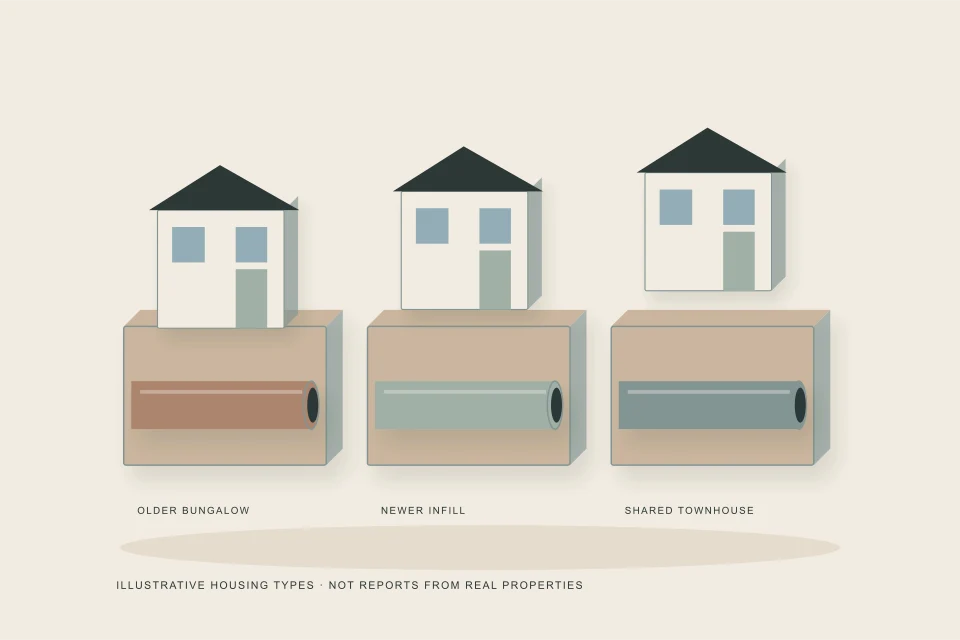
06 /Illustrative scores for Calgary house types
These examples use community patterns from the City's public-side records to show how the arithmetic behaves. They are illustrations, not assessments of real houses.
| House | Points | Band |
|---|---|---|
| 1967 bungalow in Varsity, clay tile, backyard spruce, finished basement, disclosure unknown, no scope | 3 + 2 + 1 + 1 + 1 = 8 | High |
| Same house, scope found roots and an offset | 8 + 3 = 11 | Very high |
| 1968 house in Bowness, cast iron, no big trees, unfinished basement, seller says none, no scope | 3 + 2 = 5 | Moderate |
| 1958 bungalow in Mount Pleasant, City side relined (CIPP) with a 2021 date entered, finished basement, disclosure unknown, no scope | 1 + 1 = 2 | Low |
| Same lot with the build year 1958 entered instead | 2 + 2 = 4 | Moderate |
| 2011 house in Evanston, PVC, no trees, finished basement, seller says none, clean scope | 1 − 2 → 0 | Low |
The Mount Pleasant rows show why the relining date matters. With the City's relining year entered, the house looks low risk; with the build year, it moves up a band, which is more honest about a private side that may never have been touched.
07 /What can the risk check not tell me?
- Whether the pipe is sound. Only a camera shows roots, cracks, sags or collapse.
- The private-side material, unless a scope has identified it.
- A probability of failure. Bands rank concern; they are not odds.
- Who pays. That depends on where a defect is; see who pays.
- A price. Repair costs come from a contractor's written quote; CalgarySewerReplacement.com publishes Calgary planning ranges.
When the band says it is time, request a scope with the address and your condition deadline, or read what to do after a bad scope if you already have findings.
FAQQuestions people ask
Why does an unknown pipe material score the same as clay tile?
Because an unidentified line could be anything, including the oldest materials. The check treats it as older until a camera shows otherwise, which is the cautious assumption for a buyer.
Should I enter the year the house was built or the City's installed date?
If the City record is a relining date or much newer than the house, enter the build year. The private side is usually as old as the house unless it has been replaced.
Can a Low score replace a sewer scope?
No. Low means fewer warning signs, not a sound pipe. The checklist still recommends a scope before conditions are firm.
Why does a finished basement add a point when it has nothing to do with the pipe?
It raises the cost of a backup and of any repair that has to go through the basement floor, so it raises the stakes of a sewer problem.
Does the address lookup work for condos?
Often not. The City's dataset excludes large commercial and multi-family service lines, so many condo buildings have no record.
NETWORKGo deeper across the HAUSE Sewer network
Quote comparison worksheet
Free sewer quote comparison worksheet: compare up to three quotes on price per metre, tax status, warranty and 10 key inclusions, with questions to ask.
SewerJetting.caIs hydro jetting safe for old pipes?
Is hydro jetting safe for old pipes? How jetting affects vitrified clay, cast iron, Orangeburg, concrete and plastic, and why camera-first matters.
SewerInspector.caWhat a good sewer inspection report contains
What a sewer inspection report should include: full video, distances, locate and depth marks, a line map and clear limits. A checklist to judge any report.