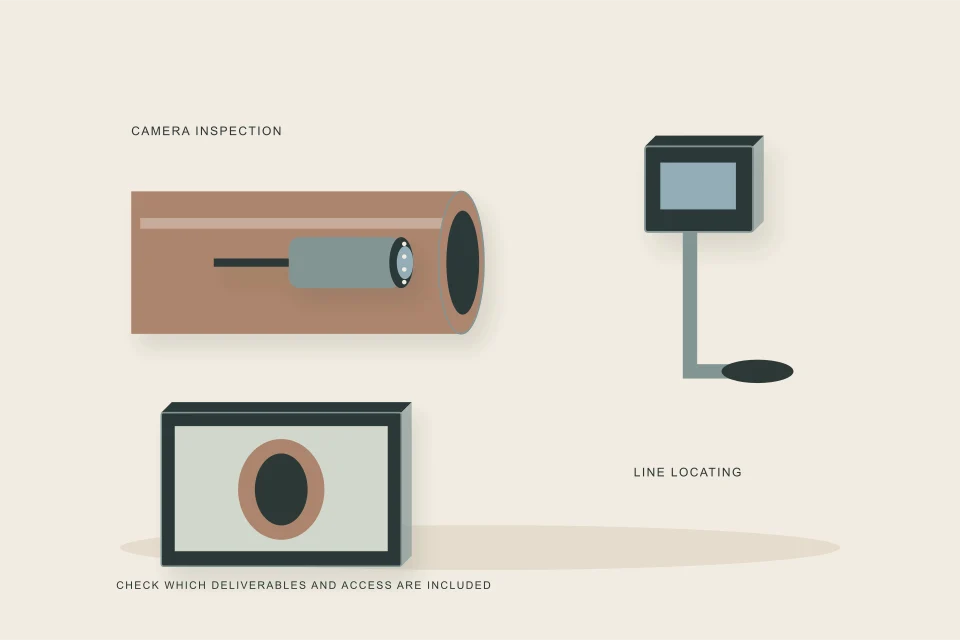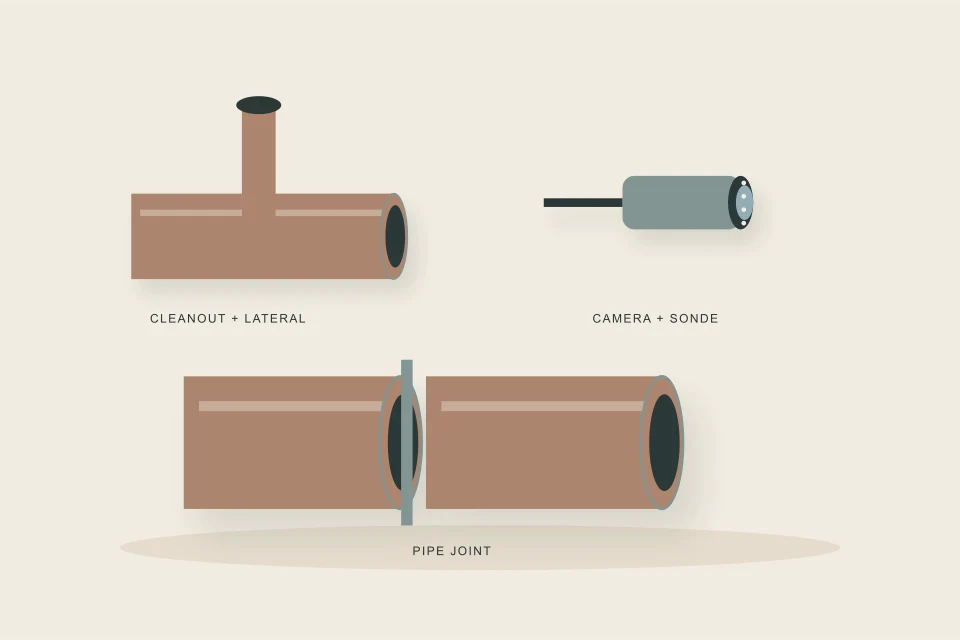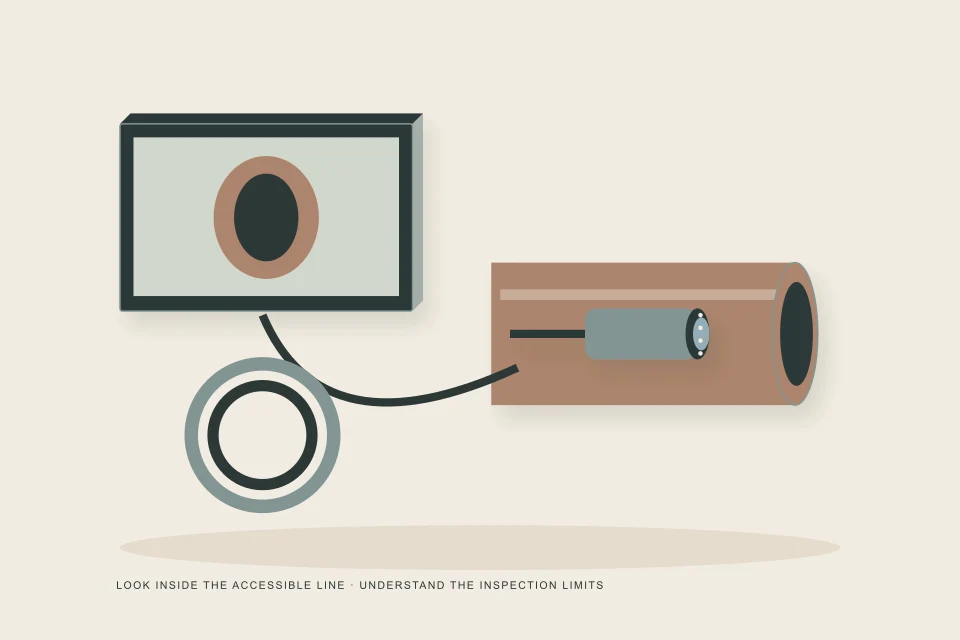
A sewer scope inspection is a recorded video inspection of the buried sanitary lateral that carries a house's wastewater to the municipal main. A camera on a push cable enters through a cleanout, travels the line and shows its material and condition: roots, offsets, sags, cracks, scale or collapse. In Calgary, buyers use it during the condition period to see a pipe no showing or home inspection can reach.
- The scope inspects the lateral: the buried pipe from the house's cleanout to the City sanitary main under the street or lane.
- A general home inspection examines readily accessible features; the lateral is buried, so it needs its own camera inspection.
- The camera identifies material and visible defects along the run, and a sonde locate can mark any defect's position and depth on the surface.
- A scope shows the pipe on one day; it cannot predict when a sound section will fail or see through water, debris or a blockage.
01 /What exactly does a sewer scope inspect?
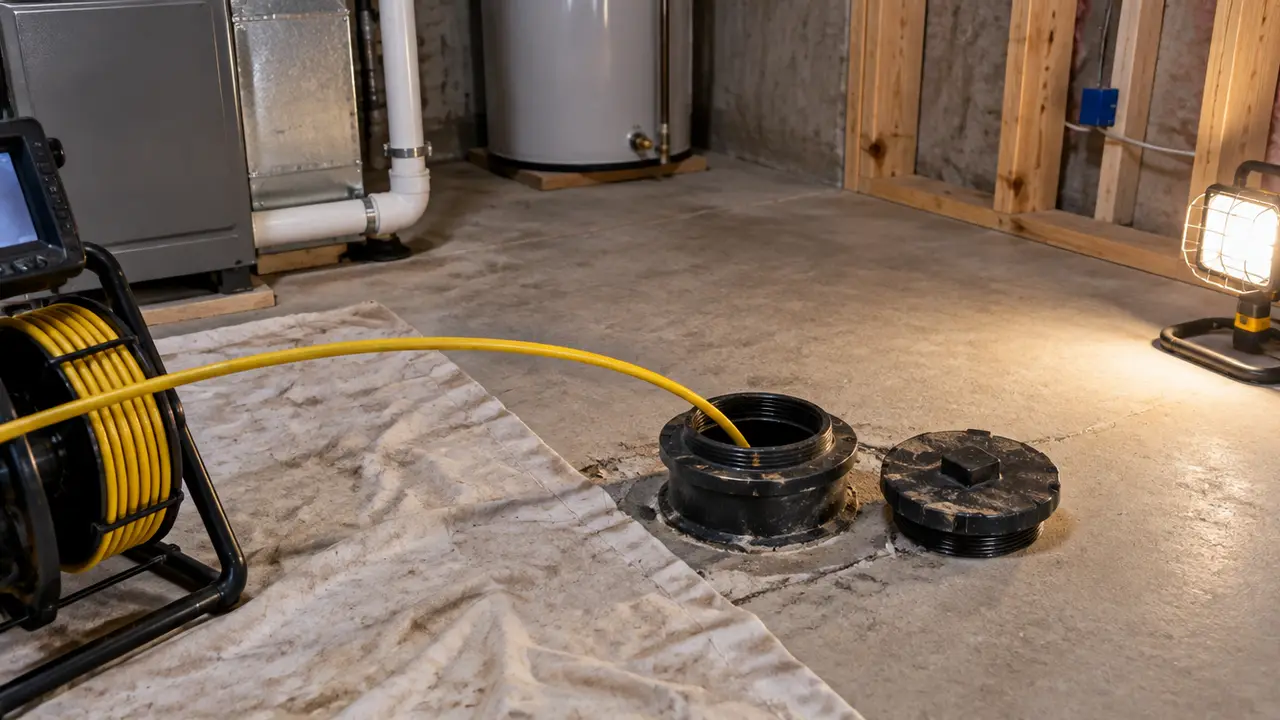
A sewer scope inspects the building sewer lateral: the single buried pipe that leaves the foundation and carries everything from the toilets, sinks, laundry and floor drains to the City's sanitary main. In most Calgary houses it runs from a cleanout in the basement floor or utility room, under the yard and toward the street or lane, where it joins the main at a connection called a tap or wye.
Calgary splits that pipe into two ownerships. The City's open data describes the sanitary service pipe in two sections: from the sanitary main to the property line, owned and maintained by the City, and from the property line to the house, owned and maintained by the homeowner. A scope usually sees both, which is part of its value: it can show whether a problem sits on your side or the City's.
02 /Why can't a home inspector see the sewer line?
A home inspector cannot see the sewer line because it is buried and the inspection is not designed to reach it. Alberta's licensing rules describe a home inspection as an opinion on a dwelling's condition based primarily on a non-invasive examination of readily accessible features. Running water in the basement shows that drains empty today; it says nothing about a root mass 15 metres out that has not yet closed the pipe.
Some home inspectors carry a sewer camera and offer a scope as a separate add-on; others refer it out. Either way it is a distinct service with its own deliverables, and it is worth confirming in writing what you are getting. Sewer scope for home buyers covers when it earns its own condition in the offer.
03 /What does the camera see?
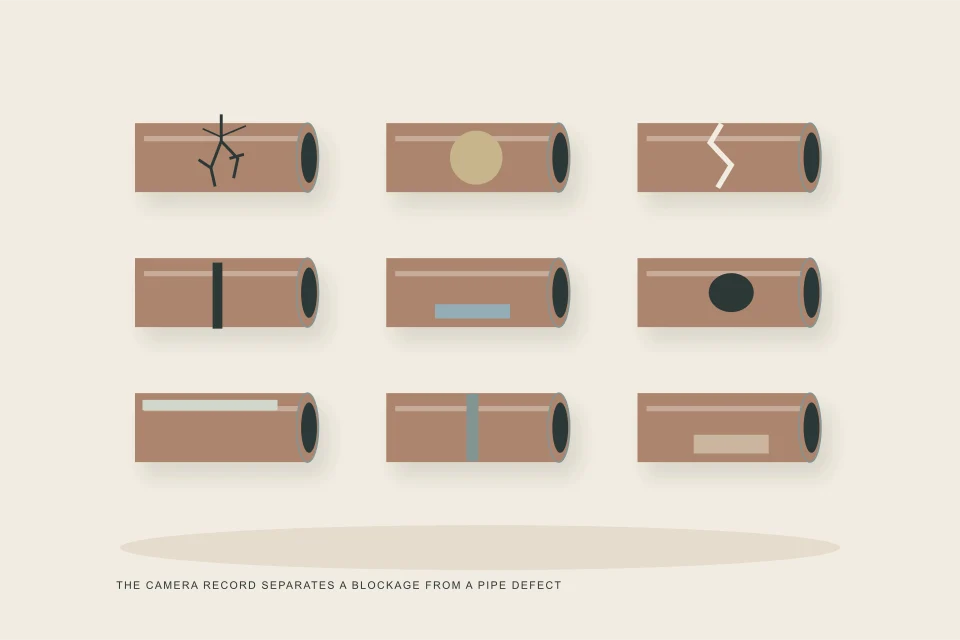
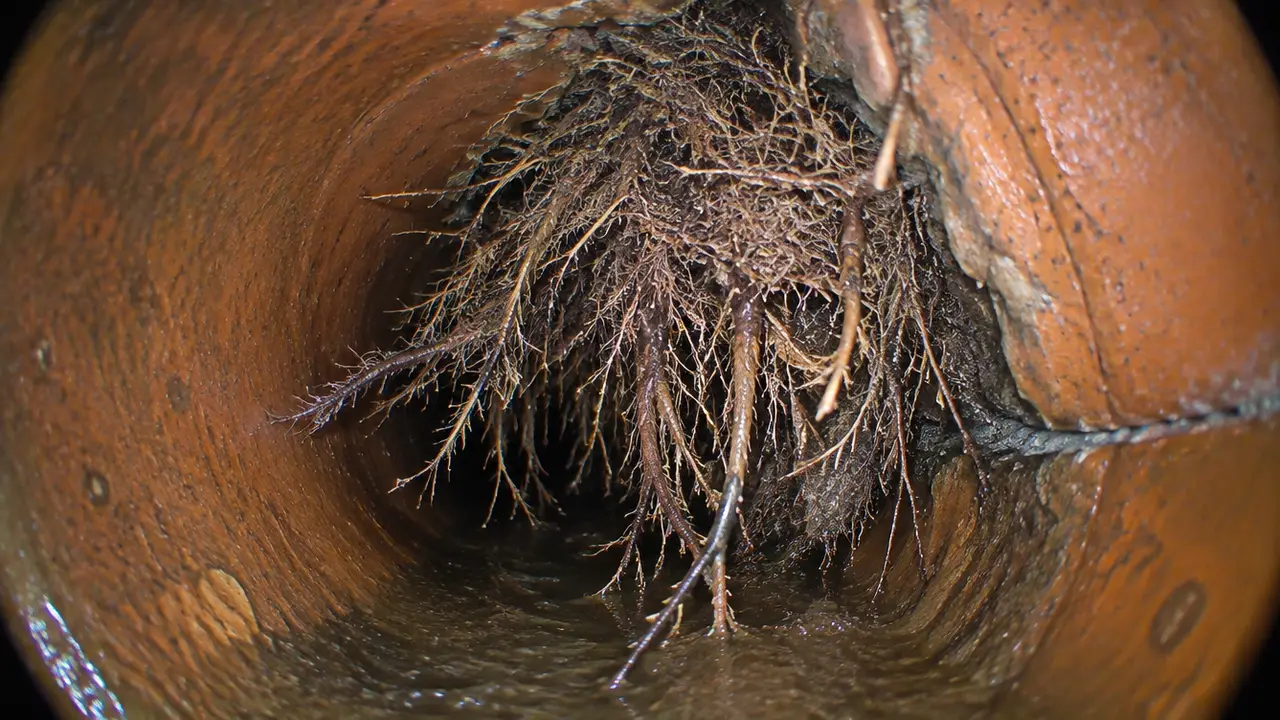
The camera sees the inside of the pipe wall wherever the head can pass and the water is low enough to show it. It records the material and any change of material along the run, and the defects that matter to a buyer.
| What it sees | What it looks like on screen | Why a buyer cares |
|---|---|---|
| Pipe material | Short clay tile sections with bell joints, dark cast iron, smooth white or grey plastic, a liner's seamless wall | Material and era hint at remaining life and repair options |
| Root intrusion | Hair-like strands or a dense mat entering at joints | Roots return after cleaning; recurring blockages |
| Offset or separated joint | A step or gap where two sections meet | Catches waste; can let soil in |
| Sag or belly | Standing water across a stretch of pipe | Solids settle and cause chronic clogs |
| Cracks and fractures | Lines or broken pieces in the wall | Can progress to collapse |
| Scale or corrosion | Rough, lumpy walls in cast iron | Narrows the bore and snags paper |
| Deformation or collapse | Pipe no longer round, or wall fallen in | Usually means replacement of that section or more |
Some older houses turn up a fibre-based pipe, often called tar paper or pitch-fibre pipe, that can deform under soil load. The City's records include codes such as TP and OTHER that the City has not defined, so a camera is the only reliable way to identify it. Common sewer line problems in Calgary describes each defect in local context.
04 /How does a sewer scope inspection work, step by step?
- Find access
The operator opens the main cleanout, usually in the basement floor or mechanical room. With no usable cleanout, a toilet may be pulled or a roof vent used; both take longer and can add cost.
- Run water
A little water helps the head slide and shows how the line drains, including where it pools.
- Push to the main
The camera travels out toward the City connection with the distance counter running, recording as it goes.
- Review on the way
The operator pauses at joints, material changes and anything unusual, noting distances and capturing stills.
- Locate if needed
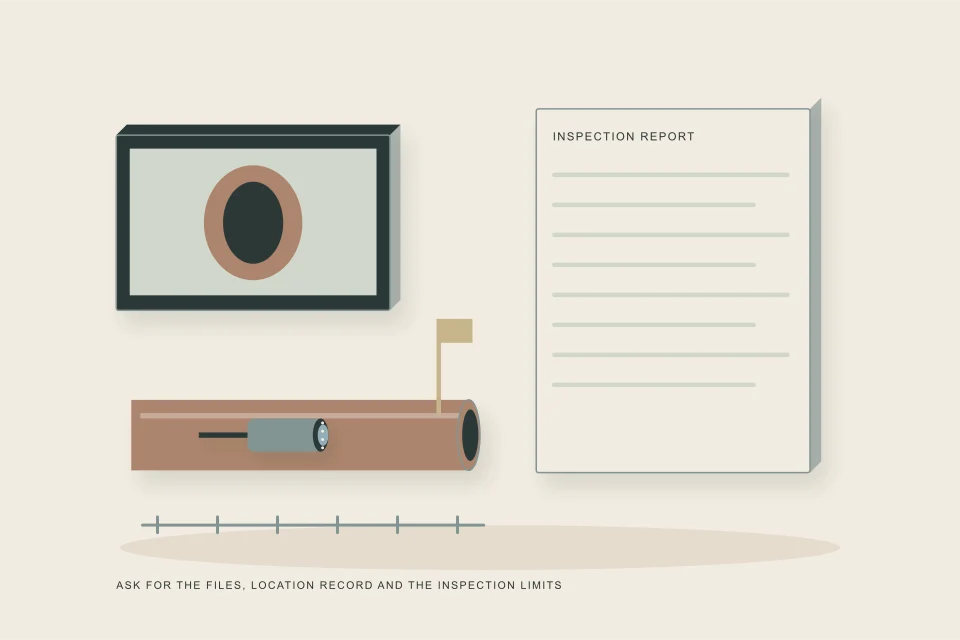
At a significant defect the camera stops while a receiver on the surface finds the sonde and the spot is marked with paint or a flag, with an estimated depth.
- Report
The full video and written observations go to the client, including where the camera stopped if it could not reach the main.
Sewer scope services explained goes deeper on the locate and the report, and locating a private sewer line covers finding the route when there is no defect to mark.
05 /How is a sewer scope different from a drain cleaning with a camera?
A sewer scope is an inspection whose product is evidence; a drain cleaning is a service whose product is a flowing line. Some cleaning visits include a quick camera look to confirm the blockage is gone, which is useful for the homeowner but rarely gives a buyer what a purchase needs: a full recording, distances, marks and a written report.
If the line is blocked when you want to scope it, the two can be combined: clear first, then run a proper recorded inspection. The cost guide covers how clean-then-scope visits are usually priced.
06 /What can a sewer scope not tell you?
- The future. A sound clay joint today can admit roots in three years. The scope is a snapshot.
- What is under water. A sag full of water hides the pipe floor; a camera can only report the length of the pooled stretch.
- Beyond an obstruction. If the head cannot pass a blockage or collapse, the rest of the line is unknown until it is cleared or reached another way.
- The legal property line. Distance from the cleanout is not a survey; property records such as a Real Property Report set the boundary.
- The price of a fix. Only a contractor's written quote, ideally based on the located defect, does that.
07 /Why does a sewer scope matter so much in Calgary?
It matters because so much of Calgary's housing sits on older pipe. The City's records for its own portion of each service line show 20.2 percent coded TIL, generally read as clay tile, and 3.3 percent cast iron, and 8.4 percent installed before 1960. Clay tile dominates records from the 1960s and 1970s; PVC takes over in the 1980s. The private side may match, or may be older still, so the camera settles it.
Finding a problem during the condition period gives three options that vanish at possession: ask the seller to repair it, negotiate the price to cover it, or walk away. Estimate your risk first with the Buyer Sewer Risk Check, then request a scope.
FAQQuestions people ask
What is the difference between a sewer scope and a sewer camera inspection?
Nothing meaningful. Sewer scope is the real estate term for a camera inspection of the building sewer lateral; operators may call it a CCTV or video inspection.
Does a sewer scope see the City's part of the pipe?
Usually, if the camera reaches the main. It can show the connection and the stretch past the property line, which helps decide whether a defect is on the City side.
Is anything dug up during a sewer scope?
No. The camera enters through an existing opening. Digging only happens later if a repair is chosen, after utility locates.
Can a sewer scope be done in winter in Calgary?
Yes. The camera works inside the pipe, which stays below frost in a properly buried line. Surface marking on snow or frozen ground may use flags rather than paint.
NETWORKGo deeper across the HAUSE Sewer network
Where is my backwater valve? How to find it, recognize it and open the cover
Where is the backwater valve in a house? How to find it, what it looks like, what access box, sleeve and cover mean, how to open it safely, and valve alarms.
SewerInspector.caHow a sewer camera inspection works, step by step
How a sewer camera inspection works, start to finish: access points, push vs crawler cameras, the footage counter, sonde locating and what limits the view.
SewerJetting.caHydro jetting weeping tile: how foundation drains are cleaned, and when they cannot be
Hydro jetting weeping tile explained: how foundation drains clog with silt, roots and iron ochre, how they are jetted from the sump, and when to replace them.