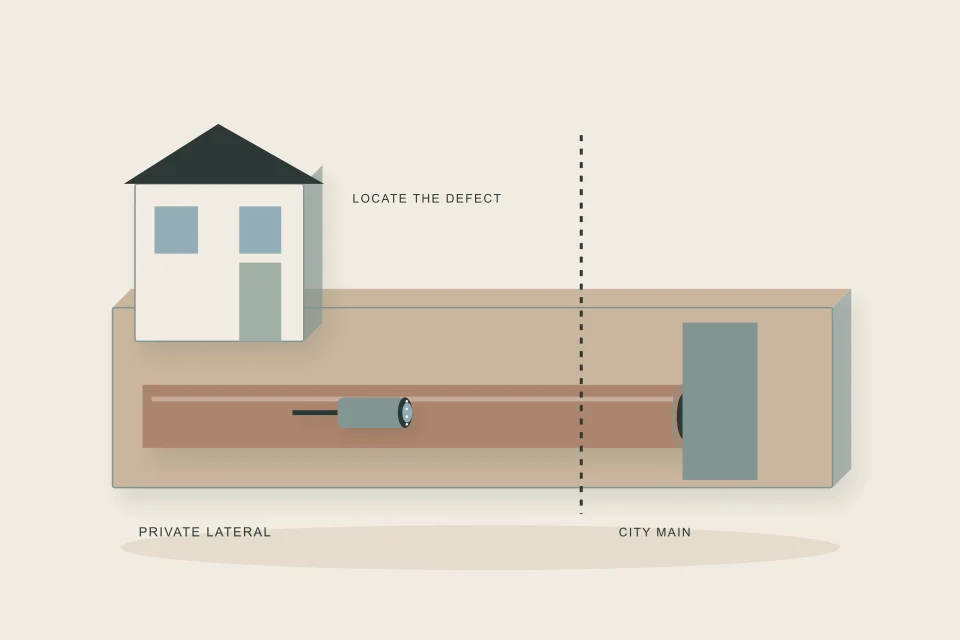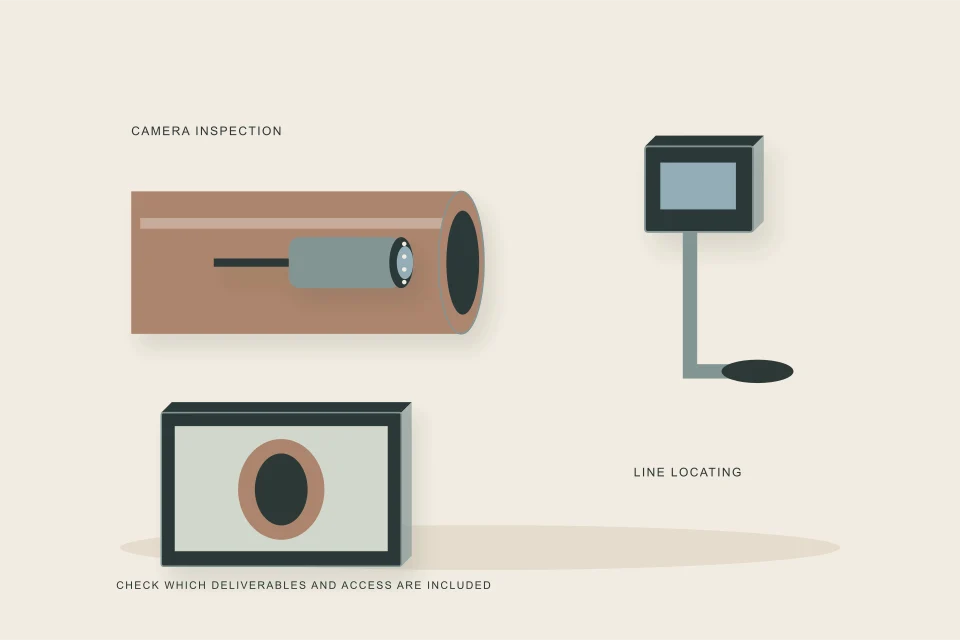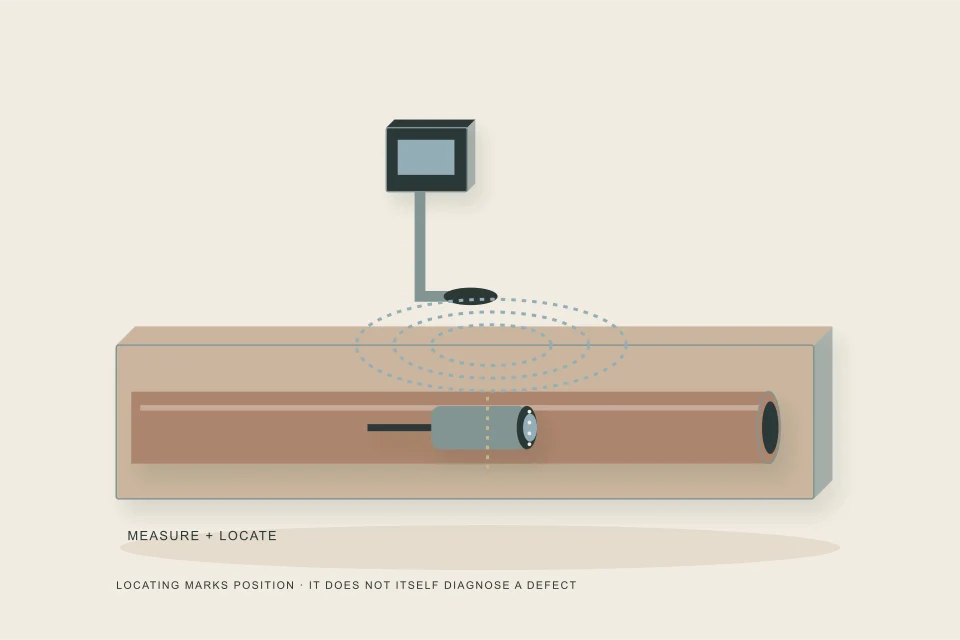
A private sewer line in Calgary is located by pushing a camera with a sonde transmitter along it and tracing the signal from the surface, marking the route and estimating depth at intervals. The utility locate system does not cover it: Utility Safety Partners says customer-owned lines such as sewer services are not registered, so a private locator or scope provider has to mark them.
- Utility locates mark registered utilities; customer-owned sewer and water services need a private locate.
- A sonde trace marks the route and depth wherever the camera can travel, not just at defects.
- Buyers want a route when trees, additions, garages or future landscaping sit over the line.
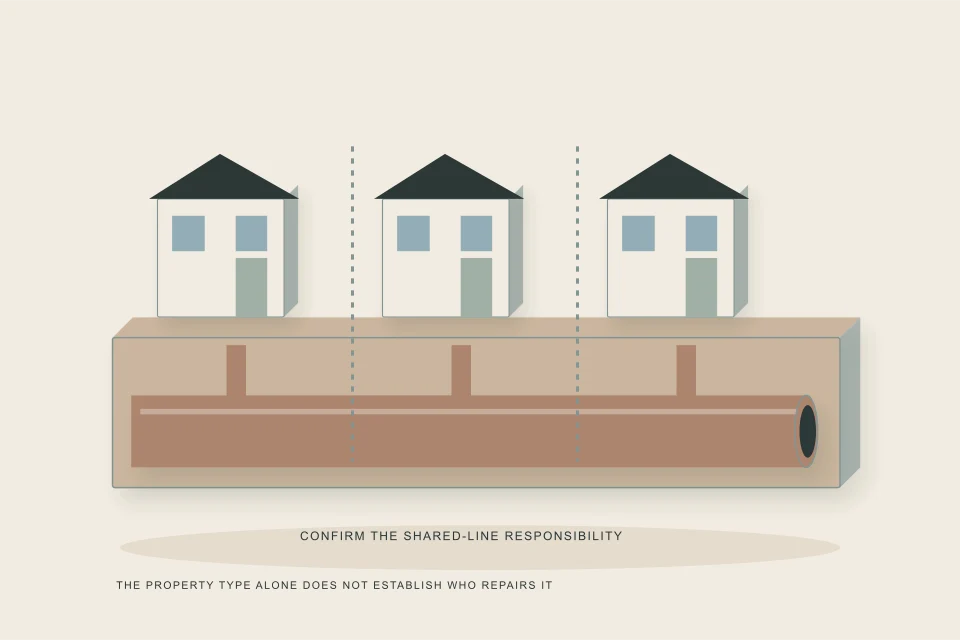
- Some older lots share part of a line with a neighbour; the route, title documents and the City's records together reveal it.
01 /Why isn't a private sewer line marked by a utility locate?
A private sewer line is not marked by a utility locate because it is not registered with the locate system. Utility Safety Partners, which handles locate requests in Alberta, lists customer-owned lines such as water and sewer service lines, sprinkler systems and lines between buildings on a property as not registered, and tells homeowners to contact a private locator to mark them in the dig area. The same page asks for requests at least three full working days before digging.
That leaves the lateral, the one buried line a buyer most wants to understand, unmarked unless someone traces it. On a scope, the operator can do that tracing with the same sonde used to mark defects.
| Question | Utility locate | Private sewer locate |
|---|---|---|
| Who arranges it | Request through Utility Safety Partners | Scope provider or private locator, booked directly |
| What it marks | Registered buried utilities such as gas, power and telecom | The private sewer lateral, and often other customer-owned lines if requested |
| When it is required | Before any ground disturbance | Whenever you need the private line's route |
| Notice | At least three full working days | Whenever a provider can attend |
| Useful for a purchase | Only if digging is planned | Yes, where the route affects repair cost or plans |
02 /How is a private sewer line traced?
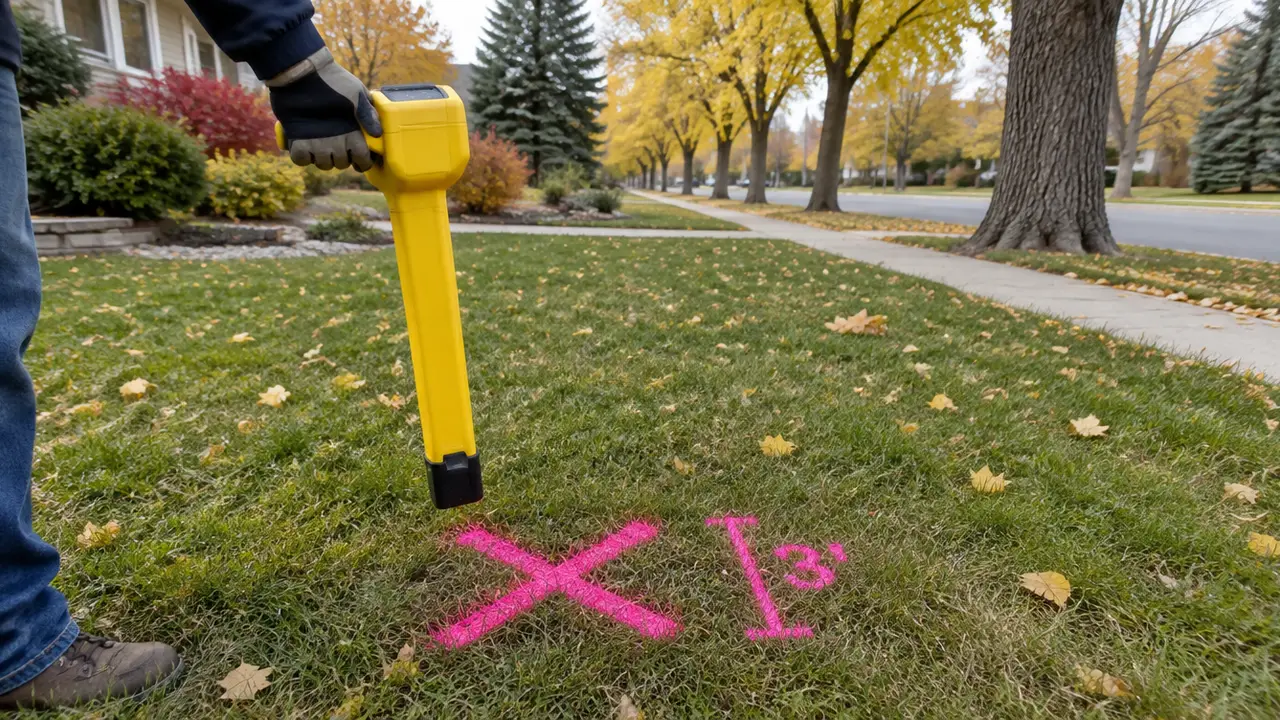
A private sewer line is traced by walking a receiver along the surface while the camera, with its sonde, moves through the pipe. The operator stops the camera every few metres, finds the peak signal, marks the spot and reads an estimated depth. Joining the marks shows the route from the foundation to the property line or beyond.
- Enter the line
Through a cleanout, a pulled toilet or another access point, as for any scope.
- Advance in steps
Stop at regular intervals and at every bend, junction and defect.
- Find the peak
Sweep the receiver until the signal peaks directly above the sonde.
- Mark and read depth
Paint or flag the point and note the estimated depth.
- Record the route
Measure the marks from fixed points such as the foundation corners, and photograph them.
Depth readings are estimates. Soil conditions, nearby metal and other lines can affect them, so treat a depth as a planning figure until someone digs to confirm it. That is one more reason a separate utility locate is required before excavation.
03 /When does a Calgary buyer need the route, not just the defects?
A buyer needs the full route when what sits above the line changes the cost or feasibility of future work. Defect marks tell you where a problem is; a route tells you what you would have to go through to reach the line anywhere along it.
- Trees over or near the line, especially large boulevard or backyard trees whose roots already reach it.
- Additions, garages, decks or sunrooms built after the house, which may sit on top of the original lateral.
- Plans to landscape, build or develop, including a garage suite, a new driveway or a laneway addition.
- Lots served from the lane, where the line crosses the backyard and often passes under a garage pad.
- Suspected shared lines, where the route heads toward a neighbour instead of the street or lane.
The Condition Deadline Scope Planner asks whether a route needs marking for exactly this reason, and adds a note to request it when booking.
04 /Do Calgary houses ever share a sewer line?
Some do, particularly older semi-detached houses, duplexes and a few older detached lots, where one private line was built to serve two homes before reaching the City's section. Who owns and maintains a shared line depends on the title documents, any easement or agreement, and the City's records, and it can be unclear. A route that heads toward a neighbour, a junction the camera finds under the yard, or a City record that covers two addresses are all clues.
| Clue | Where it shows up | What to do |
|---|---|---|
| Route heads toward the neighbour, not the street or lane | Sonde trace | Continue the trace; note where it joins |
| A junction on the private side | Scope video | Ask the operator to record which way each branch runs |
| Duplex or semi-detached house | Listing | Ask whether each side has its own lateral |
| Easement or agreement on title | Title documents | Have your lawyer explain what it covers |
| Neighbour's backups coincide with yours | Seller disclosure or history | Ask directly; it may be one line |
A shared line matters to a buyer because a defect on it may need the neighbour's cooperation and cost-sharing to fix. Find out before waiving conditions, and have your lawyer look at title. CalgarySewerReplacement.com covers shared-line repairs after purchase.
05 /Can the City's records help locate the line?
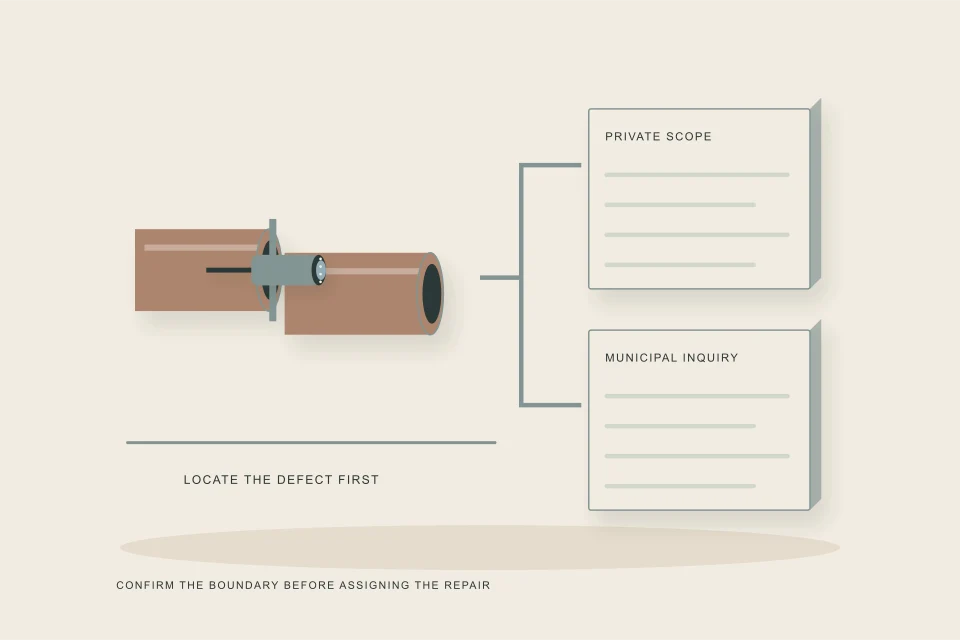
The City's records help with the City section, not the private route. The City publishes its public sanitary service lines as open data that can be viewed as a map, showing roughly where the City's section of a service line meets the property. That tells you which side of the lot the line exits and whether it goes to the street or the lane. It does not show the private route across the yard.
Two field clues help with orientation. The City's water service valve is usually located at or near the property line, and the sewer often, though not always, leaves the house on the same side as the water service. Neither replaces a trace. For how the route and the property line combine to decide ownership, see city vs. private.
06 /What does locating cost, and how is it booked?
When you book, say what you need the route for. A buyer checking whether a garage sits over the line needs marks near the garage; a buyer planning a new driveway needs the full path across the front yard. Photographs of the marks, taken with a tape from the foundation corners, keep the information after the paint fades.
Locating at defects is often part of a scope-plus-locate package; tracing the full route may be quoted as an add-on or a separate visit. Ask for it by name when you book.
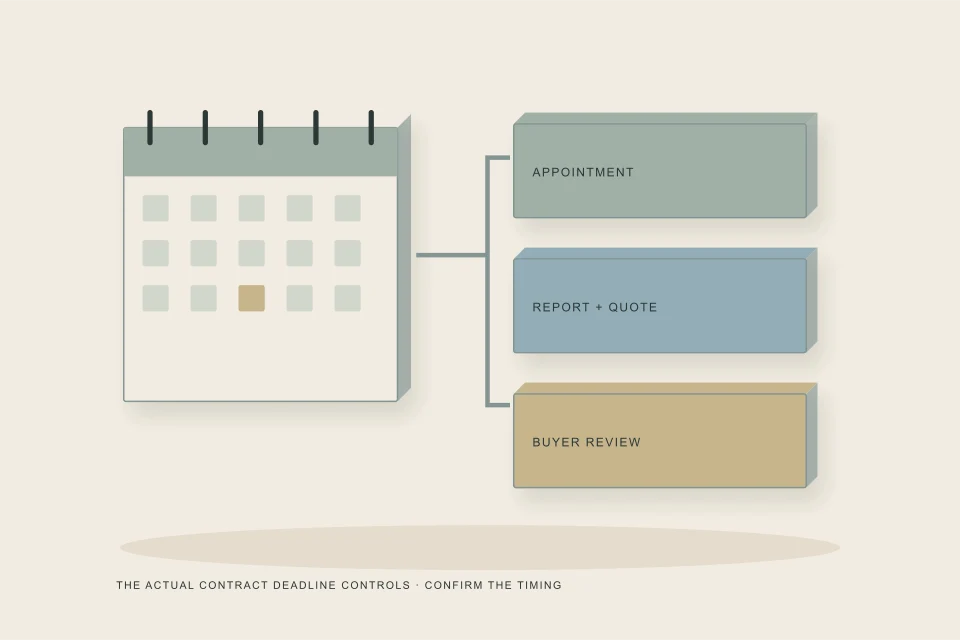
Before anyone digs, a utility locate request is still required, with at least three full working days' notice. To book a scope with a route trace, send a request and describe what sits over the line; sewer scope services explains the locate step, and who pays covers what a located defect means for the bill.
FAQQuestions people ask
How do I find out where my private sewer line runs?
Book a scope with a sonde trace. The operator follows the camera from the surface and marks the route and depth at intervals from the house to the property line.
Will Utility Safety Partners mark my sewer line?
No. Utility Safety Partners says customer-owned lines, including sewer service lines, are not registered with it. Use a private locator or scope provider.
How deep is a private sewer line in Calgary?
It varies by house and lot, and lines are laid deep enough to stay below frost. A sonde gives an estimated depth at each mark; confirm by excavation before relying on it for construction.
Can a garage or addition be built over a sewer line?
It is sometimes done but makes future repairs harder and costlier. Find the route first and ask a contractor and the City about requirements before building.
How do I know if my house shares a sewer line with the neighbour?
Trace the route, look for junctions on the scope video, check title for easements, and ask about coinciding backups. Your lawyer can explain any agreement on title.
NETWORKGo deeper across the HAUSE Sewer network
Sewer line locating and depth: how the mark on your lawn is made
How sewer line locating and depth readings work: the sonde, the hand-held locator, peak and null readings, marking, accuracy, and calling before you dig.
SewerRoots.caWhose tree, whose pipe: who pays when roots block a sewer line
Who is responsible when a city or neighbour's tree sends roots into your sewer line: the general Canadian pattern, the evidence, and how to raise it.
SewerQuotes.comWho pays for sewer repair: buyers, sellers, landlords, tenants and condo owners
Who pays for sewer repair in Canada: buyer vs seller, landlord vs tenant, condo corporation vs unit owner, and neighbours who share one sewer lateral.