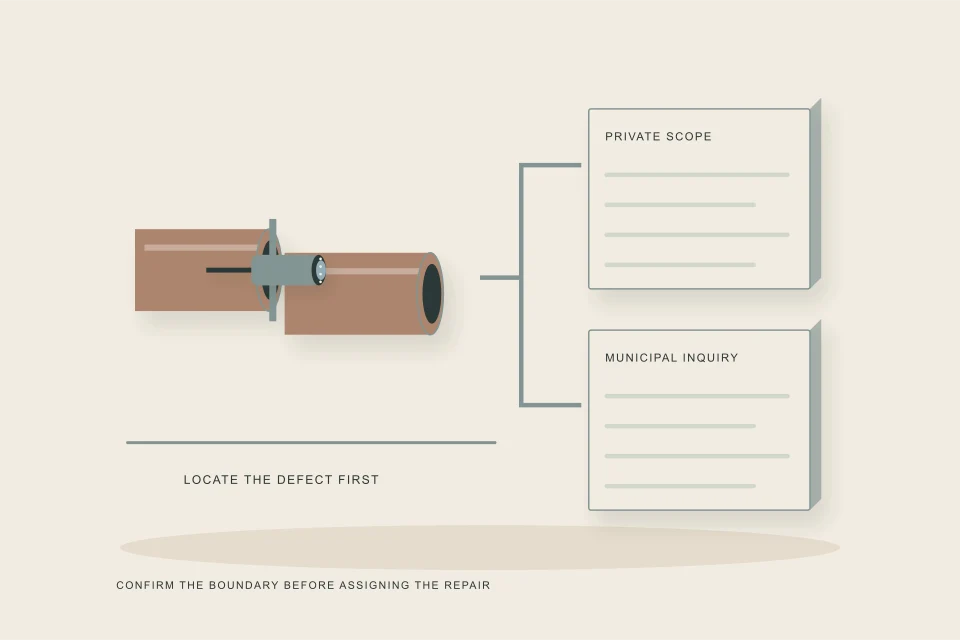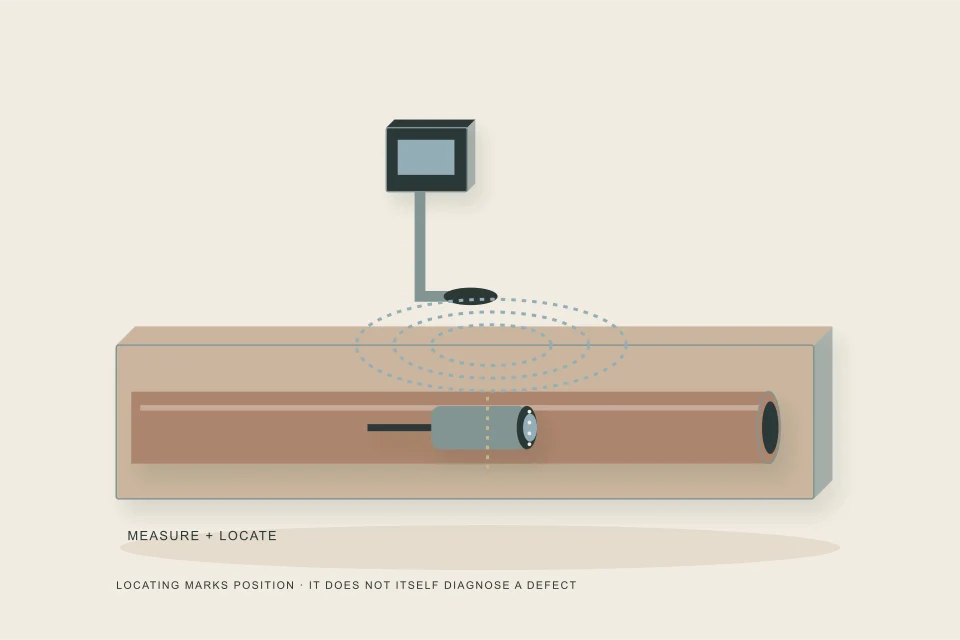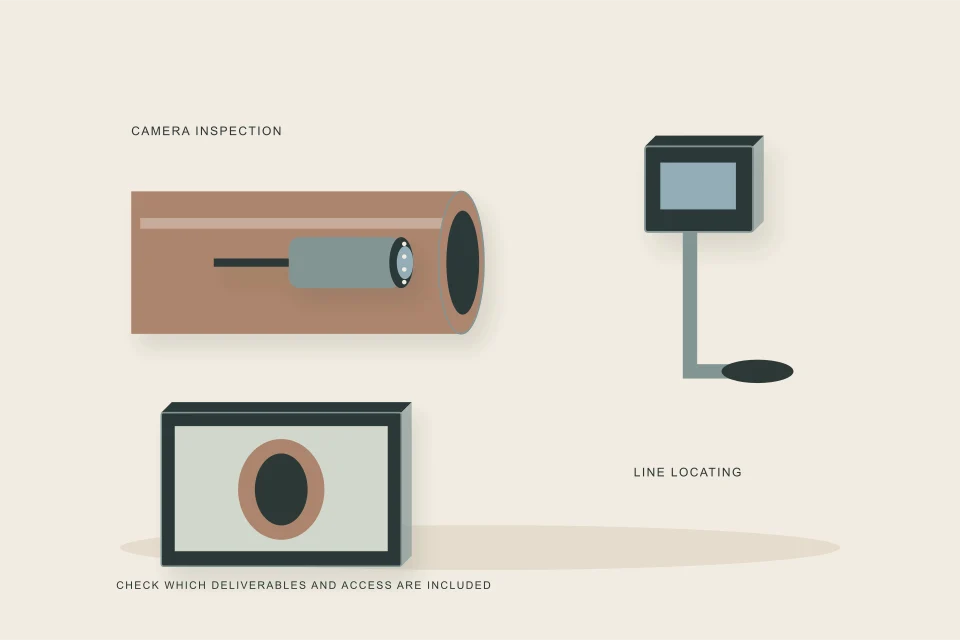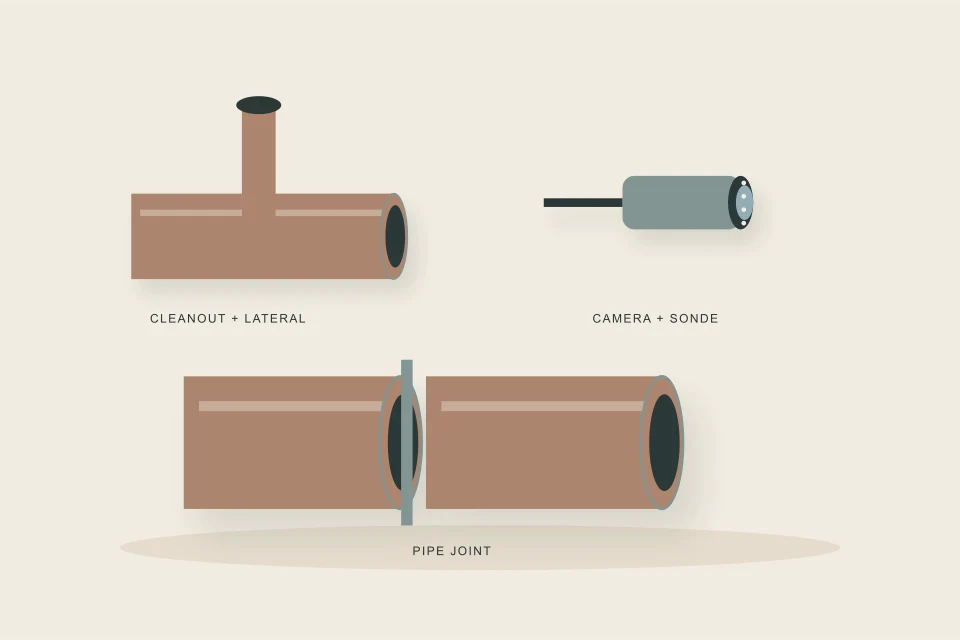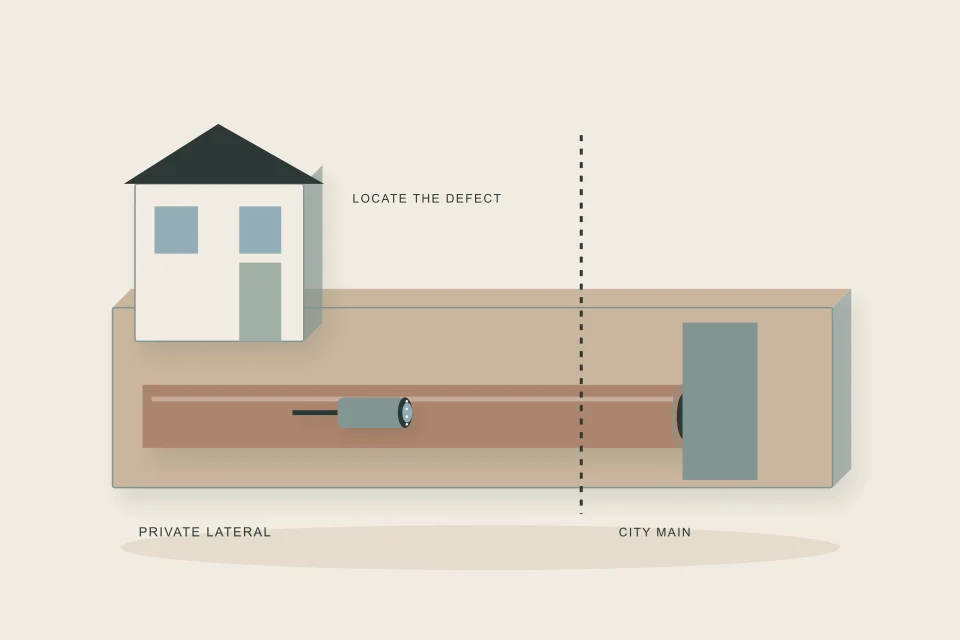
To tell whether a sewer defect is on the City or private side in Calgary, compare three things: the defect's surface mark from a sonde locate, the property line shown on a Real Property Report or survey, and a tape measurement between them from a fixed point such as the foundation. The camera's distance counter alone is not enough, because it includes pipe inside the house and follows bends.
- The City's and the owner's sections meet at the property line, which in most cases sits a few metres back from the curb or sidewalk, not at the curb.
- The camera counter measures cable along the pipe from the entry point, not straight-line distance from the foundation to the defect.
- A surface locate converts the defect into a point on the ground that can be measured against the lot boundary.
- A Real Property Report prepared by an Alberta Land Surveyor shows the boundaries; a surveyor can stake them when a defect is close.
01 /Where does a Calgary sewer line change from private to City?
A Calgary sewer line changes from private to City at the property line. The City's description of its sanitary service data puts the owner's section between the house and the property line and the City's section between the property line and the main. The trouble for buyers is that the property line is invisible, and it is rarely where people assume.
Most people picture the boundary at the curb or the sidewalk. The City's water service page says that in most cases the property line ends a few metres from the edge of the curb or sidewalk, which means the strip of grass between the sidewalk and your lawn, and sometimes part of what looks like your front yard, may be City land. On lots served from the lane, the main runs behind the house and the boundary is at the rear, so the same logic applies in the other direction.
02 /Why isn't the camera distance enough to decide?
The camera distance is not enough because it measures something different from the boundary. The counter records how much cable has gone into the pipe from the point of entry. That entry point is usually a cleanout inside the basement, several metres behind the front wall, and the pipe may bend, drop or angle across the lot on its way out. A reading of 18 metres can land well short of, or well past, the property line depending on the route.
| Factor | Effect on the counter | How to correct for it |
|---|---|---|
| Entry point inside the house | Counter includes pipe under the basement floor | Measure from the foundation wall to the surface mark instead |
| Bends and angled runs | Counter follows the pipe, not a straight line | Use the sonde mark, which is where the head actually is |
| Drop from basement to lateral depth | Vertical run adds to the count | Use the locate's depth reading separately |
| Toilet or roof vent entry | Counter starts even further from the lateral | Note the entry point in the report and measure on the surface |
| Zero point not stated | Readings cannot be compared between visits | Ask the report to state where zero was set |
03 /How do I find where the property line is on the ground?
You find the property line from property records, then measure to it. The usual document in an Alberta resale is a Real Property Report, which RECA describes as prepared by an Alberta Land Surveyor and showing the property boundaries and the structures on the lot. The RPR shows the distance from the front of the house to the front boundary, which is exactly the number needed.
- Get the RPR
Ask your Realtor for the Real Property Report in the listing documents. Check that it is current and shows the house as it stands today.
- Read the setback
Note the distance from the house's front wall (or rear wall for a lane service) to the property line.
- Measure the mark
With the defect located and marked, tape from the same wall to the mark, square to the wall.
- Compare
If the mark is well inside the setback, the defect is on the private side; well beyond, it is likely on the City side.
- Escalate close calls
Within a metre or so of the line, ask a land surveyor to locate the boundary before anyone agrees who pays.
Two field clues can help, but neither decides it. The City's water service valve is usually located at or near the property line, and the City says those valves are City-owned and operated, so look but do not touch. Survey pins, if you can find them, mark the lot corners. The City's public service line data can also show roughly where the City section starts at your address.
04 /How does this work on a real lot? A worked example
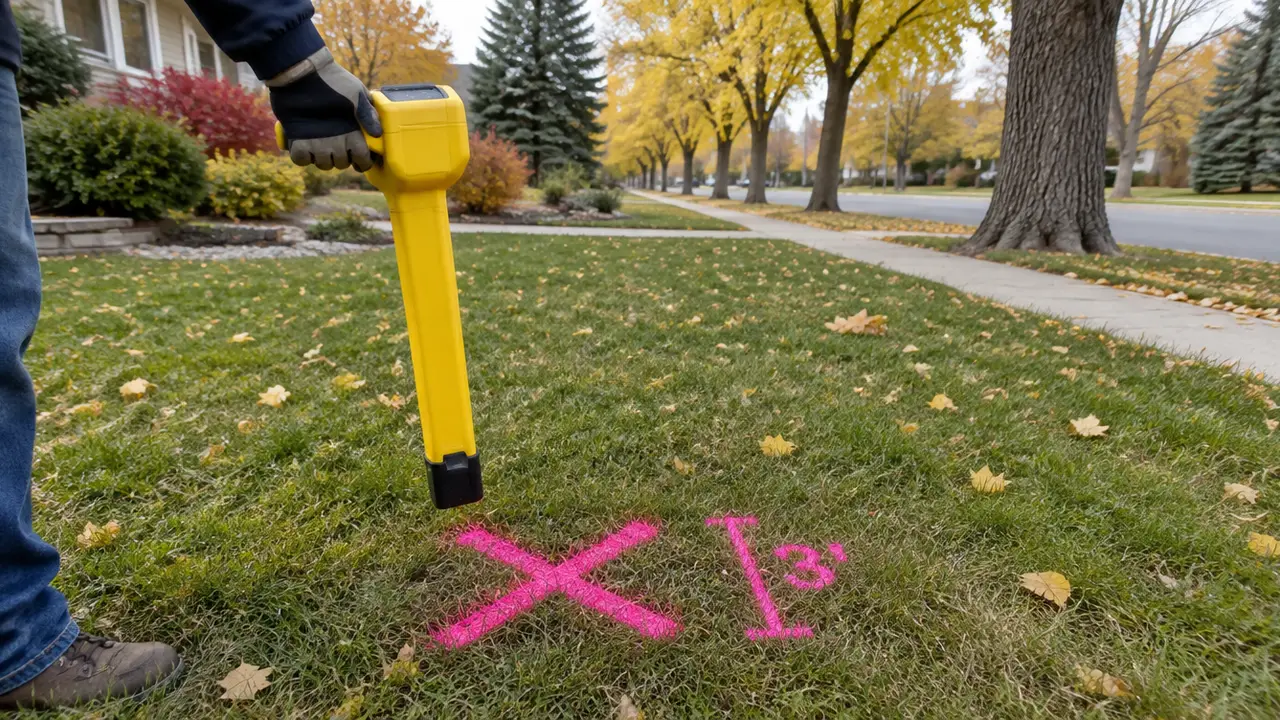
Take an illustrative bungalow with a basement floor cleanout 3 metres behind the front wall and a lateral running straight out to a main under the street. The scope finds an offset joint at 19.5 metres on the counter. The locate marks it in the front lawn at an estimated depth of 2.3 metres.
| Measurement | Value | Where it comes from |
|---|---|---|
| Counter reading at the defect | 19.5 m | Scope report |
| Cleanout to front wall | about 3 m | Measured in the basement |
| Front wall to surface mark | 15.8 m | Tape on the lawn, square to the wall |
| Front wall to property line | 16.4 m | Real Property Report |
| Mark relative to line | about 0.6 m inside | Difference of the last two rows |
On the counter alone, 19.5 metres looks like it could be under the City boulevard. On the ground it sits about 60 centimetres inside the lot, which makes it a private-side repair, and close enough to the line that a buyer with a lot riding on the answer might ask a surveyor to confirm. The same scope with no locate would have left everyone guessing.
05 /How do lane-served and corner lots change the measurement?
Lane-served and corner lots change which boundary matters. Many older Calgary lots send the lateral out the back to a main in the lane, so the relevant property line is the rear one, and the measurement runs from the back wall of the house across the yard, often under a detached garage or parking pad. The RPR shows the rear setback just as it shows the front one.
Corner lots can be served from either street, or from the lane, and the lateral sometimes leaves the house on the side nobody expects. Before measuring anything, confirm the direction the camera travelled and which main it reached. A sonde trace of the whole route, described in locating a private sewer line, settles it when the report is unclear.
- Lane service: measure from the rear wall to the mark and compare with the rear setback.
- Corner lot: confirm which main the camera reached before choosing a boundary.
- Garage over the line: the mark may fall inside the garage footprint; measure from the house, not the garage.
06 /What should I do once I know which side the defect is on?
- Private side: get a written repair quote based on the mark and depth, and take it into the negotiation. Who pays covers how buyers and sellers share the cost.
- City side: call 311, describe the finding and its measured position, and keep the video and photos of the mark ready.
- Straddling or too close to call: confirm the boundary with a surveyor before accepting either answer.
- Anything involving digging: a utility locate request is required first; customer-owned lines such as sewer services are not registered with Utility Safety Partners, so a private locator marks those.
If the lateral's route is unknown or it seems to run toward a neighbour, locating a private sewer line explains tracing it. To get the evidence in one visit, request a scope with locate and marking.
FAQQuestions people ask
Is the grass strip between the sidewalk and my lawn City property?
Often, yes. The City says the property line in most cases ends a few metres from the curb or sidewalk. Your Real Property Report shows where it is for your lot.
Can I use the water shut-off valve in the yard to find the property line?
It is a clue, not proof. The City says the service valve is usually at or near the property line, and it is City-owned, so do not operate it. Use the RPR to confirm.
What if my house has no Real Property Report?
Ask your Realtor and lawyer; RPRs are common in Alberta resales. Without one, a land surveyor can locate the boundary if a defect is close to the line.
Does the scope report say whether a defect is City or private?
Some reports give an opinion based on distance and the locate. Treat it as a starting point and confirm against property records before relying on it.
NETWORKGo deeper across the HAUSE Sewer network
How a sewer camera inspection works, step by step
How a sewer camera inspection works, start to finish: access points, push vs crawler cameras, the footage counter, sonde locating and what limits the view.
SewerRoots.caRoots in the main sewer line: is it your lateral or the city's sewer main?
Roots in the main sewer line: how to tell your own lateral from the city sewer main, clues that point to the public side, and who to call first.
SewerJetting.caHydro jetting tree roots: what it clears, and why the roots come back
Hydro jetting tree roots in a sewer line: root nozzles vs cable cutters, why roots regrow at the same joints, clay pipe care, and when to line instead.